
Cladding Contractor Sydney | Non Compliant Cladding Replacement
Sydney Contracting Engineers (SCE) Corp delivers audited cladding replacement for Project Remediate and private programs. Our Construction Cladding Sydney services cover assessment plus safe removal plus installation of certified non combustible systems that align with AS 5113 and NCC 2019.
We specialise in buildings affected by Non Compliant Cladding NSW and we support DBP documentation plus compliance records plus fire testing evidence. Our Cladding Contractor Sydney team manages design inputs plus engineering support plus safe installation using BMU access plus traffic control plus verified site processes. Each Construction Cladding Sydney project follows strict quality checks and delivers clear compliance packs for owners and councils.
SCE operates as a Cladding Contractor Sydney option focused on safe delivery plus risk control plus long term performance. With experienced Construction Cladding Sydney management and precise planning for Non Compliant Cladding NSW remediation we support reliable outcomes across Sydney and NSW.
SCE Building supports residential plus commercial plus industrial sites that need compliance with minimal disruption. Our Construction Cladding Sydney team confirms cladding type plus interfaces plus evidence then replaces Non Compliant Cladding NSW materials with documented installation and testing support.
We supply and install compliant exterior and interior systems across Sydney and NSW. Our Cladding Contractor Sydney delivery includes assessment plus supply plus installation plus replacement scope control. Construction Cladding Sydney works are planned to meet current requirements and support safe building outcomes.
Our services align with AS 1530.4 fire testing criteria and Fire Resistance Levels. Beyond compliance our Cladding Contractor Sydney team completes building checks that support structural integrity plus insulation plus overall performance. Every Construction Cladding Sydney stage is managed to deliver safe durable outcomes.
At SCE Building we treat cladding as a value and safety upgrade. Construction Cladding Sydney solutions can lift building performance when supported by correct selection and verified installation. Where Non Compliant Cladding NSW is present we plan remediation to support safer use and long term reliability.
Choose SCE Building for a Cladding Contractor Sydney team that delivers clear scope plus controlled delivery plus consistent records. Our Construction Cladding Sydney focus and practical management of Non Compliant Cladding NSW supports safe compliant outcomes.
Cladding Contractor Sydney | Recladding Non Compliant Cladding
At SCE Building, our Construction Cladding Sydney services improve safety plus weatherproofing plus long term performance. Your Cladding Contractor Sydney scope is backed by fire testing requirements and verification steps for Non Compliant Cladding NSW upgrades.
Our comprehensive cladding services encompass:
- Enhancing overall safety standards
- Ensuring effective weather proofing
- Promoting energy efficiency
- Enhancing acoustic performance
- Installation of compliant cladding adhering to AS1530.1
- Reviewing compliance with AS 1530.4 for fire safety and FRL requirements
- Conducting building assessments for structural adequacy, integrity and insulation.
historical event
Uncontrolled fire due to Combustible Cladding
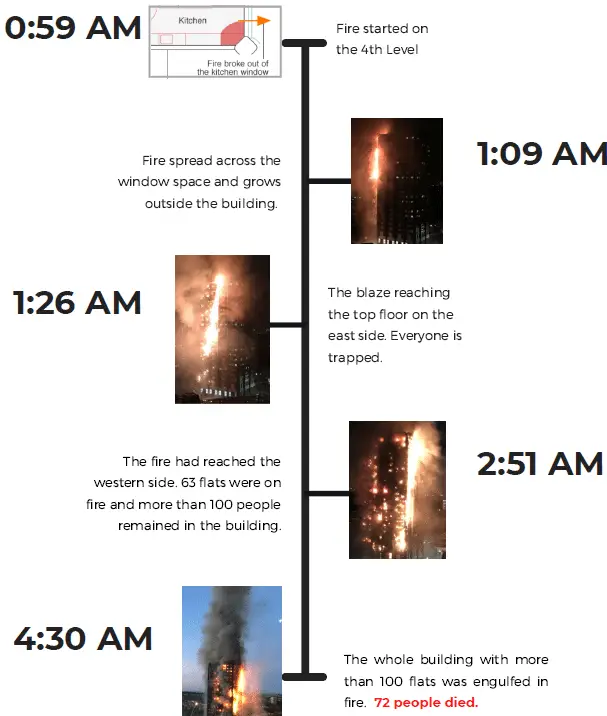
Grenfell Tower, a 24 storey block in West London was covered in fire.
It took just 90 minutes for the fire to race up 20 storeys of the Grenfell Tower in June 2017.
It took 24 hours to get it under control and 60 hours to extinguish it fully; killing 72 people and 70 more were injured.
The reason why the fire was propagated in such a high velocity, was due to the Combustible Aluminium cladding used in the facade of the building.
Aluminium composite panel Flammable core | ||
Insulating core | Heat from a fire will conduct quickly to the core through thin aluminium | Core loses ability to bind, causing outer skins to deform and delaminate |
Surfaces | Core melts and can ignite | |

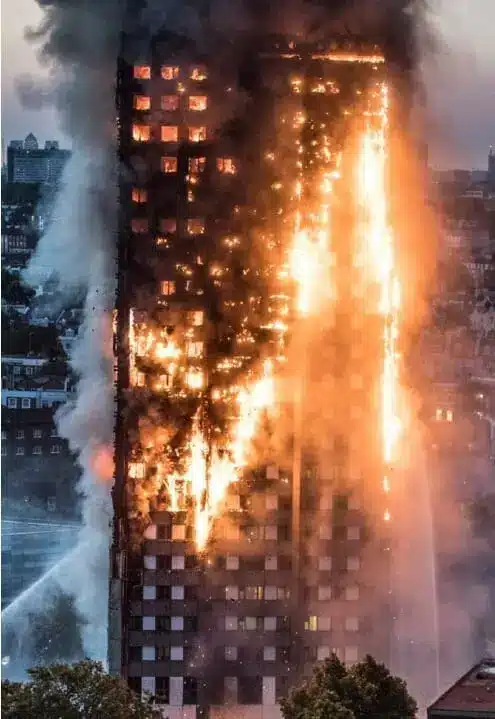
Grenfell Tower on fire
Uncontrolled fire due to Combustible Cladding
common types of cladding | EPS | Cladding Contractor Sydney
Expanded Polystyrene
Expanded polystyrene is a type of composite cladding. It was well received in the market due to its insulating properties, light weight and low cost, however, is combustible and increases the likelihood of fire spreading more quickly.
It may shrink, melt or ignite when exposed to elevated temperatures. For this reason, it is not considered safe for use on multi storey buildings.
EPS has been used widely in the Australian Building Industry over the past 20 years.

ACP | Cladding Contractor Sydney
Aluminium Composite Panel

ACP cladding panels are composite products made from two aluminium outer layers bonded to a core material, which may be polyethylene, mineral based, or a combination of both. These panels generally range in thickness from 3mm to 5mm and are widely used as architectural building elements. Although many ACP products look similar externally, they differ significantly in the core materials used, which affects their performance, durability, and compliance requirements.
ACP categories | Cladding Contractor Sydney
Aluminium Composite Panels (ACP) are often split into categories based on the amount of polymer core contained between the two aluminium layers. The categories are specified as per below:

The highest risk ACP products have a 100 percent polymer core usually polyethylene which is often black and classified as ‘PE’.
Products known as FR have been found to contain approximately 30% of polymer content in the core. It has the potential to quickly spread the fire depending on how the project is used.


Products known as ‘A2’ ordinarily have less than 10% polymer in the core and the potential to spread fire is low.
Materials chart
Material | Material | Material | Material | Material |
Mitsubishi | Aluminium | Japan | 1. Limited range in Australia | 1. Available in more than 20 colours |
Alcadex NC | Aluminium | China | 1. Limited range in Australia | 1. Available in more than 30 colours |
Larcore | Honey Comb | spain | 1. Limited range in Australia | 1. Available in more than 30 colours |
Alfrex Solid | Solid | South | 1. Limited range in Australia | 1. Available in more than 30 colours |
Mondoclad | Solid | China | 1. Limited range in Australia | 1. Available in more than 20 colours |
VitraDual | Solid | China | 1. Limited range in Australia | 1. Available in more than 130 colours |
Decoclad | Solid | Australia | 1. Locally manufactured | 1. Available in timber look |
Material | Material | Material | Material | Material |
Mitsubishi | Aluminium | Japan | 1. Limited range in Australia | 1. Available in more than 20 colours |
Alcadex NC | Aluminium | China | 1. Limited range in Australia | 1. Available in more than 30 colours |
Larcore | Honey Comb | spain | 1. Limited range in Australia | 1. Available in more than 30 colours |
Alfrex Solid | Solid | South | 1. Limited range in Australia | 1. Available in more than 30 colours |
Mondoclad | Solid | China | 1. Limited range in Australia | 1. Available in more than 20 colours |
VitraDual | Solid | China | 1. Limited range in Australia | 1. Available in more than 130 colours |
Decoclad | Solid | Australia | 1. Locally manufactured | 1. Available in timber look |
substructure chart
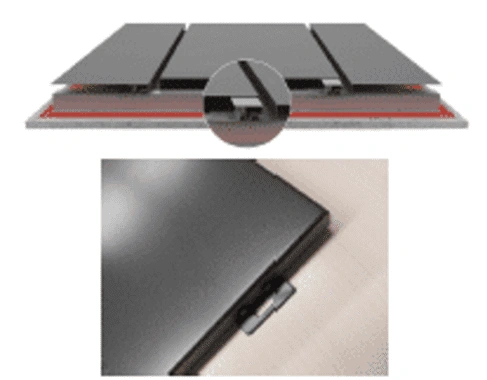
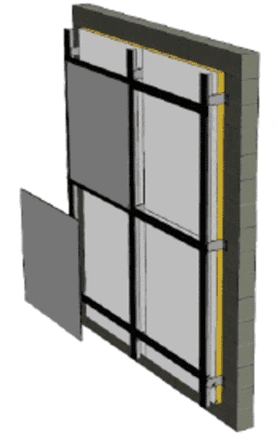
Cassette Fixing | Face Fixing | Tongue and Groove | |
Waterproofing | No Additional waterproofing for substructure required | vapour barrier required | No additional waterproofing for the substructure required. |
Limitation | 1. Suitable for horizontal or vertical application on low to high rise buildings | 1. Suitable for horizontal or vertical application on low to high rise buildings | 1. Suitable for small areas and architectural design |
Information | 1. Prefabricated in a factory environment and can accommodate clients requirements.
| 1. To be installed step by step using rivets.
| 1. The panel is specifically design for tongue and groove fixing and cannot be fixed any other way.
|
assuring performance | Cladding Contractor Sydney

external cladding requirements
When it comes to Cladding Installation Services or recladding, there are multiple factors that dictate what type of substructure or material is to be utilised. These factors are determined through systematic analysis of the structure, building design, building height, building location, cladding type, sprinkler systems, form of construction and wind loads. For this reason, every building needs a different approach in terms of material specification, substructure and installation in Cladding Installation Services.
According to the Australian Building Codes Board (ABCB), there are two main issues resulting in the use of non compliant cladding and installation methods, they are:
(1) First, a lack of understanding about what evidence should be sought in order to confirm product suitability for an external cladding in Cladding Installation Services.
- Manufacturers and suppliers may not be clear about the information or test parameters required to ensure compliance.
- For designers, information provided by the suppliers may be inconclusive in demonstrating compliance with the BCA, compromising their ability to choose appropriate cladding products for Cladding Installation Services.
- Regarding builders, installation guidelines may not clearly establish compliance requirements, hence builders may rely on their own experience in assessing cladding products on site. In these circumstances, it is possible that a non compliant method could be utilised.
- For building certifiers, the information about a product installed on a building may not be sufficient to enable them to definitively assess the finished product as non compliant.
(2) Additionally, installers may deviate from the specified designs and substitute products which may not be able to meet fire resistance requirements. Substitution is typically done to lower costs; however, it jeopardises quality in Cladding Installation Services.
At Sydney Contracting Engineers we close up the industry gap between manufacturer, supplier, fabricator, engineer, designer, builder and installers to ensure only compliant finished products are achieved across all our projects.
"when it comes to safety and design, attention to detail could save lives"
Frequently Asked Questions
1. What does cladding services mean for an existing building?
2. What is included in cladding replacement?
3. What is the difference between recladding and cladding repair?
4. What cladding issues are most common in Sydney buildings?
5. Can cladding works be done while the building is occupied?
6. How is waterproofing handled during cladding replacement?
7. What evidence supports compliant cladding installation?
8. Can cladding works align with DBP requirements?
9. What drives the cost of cladding replacement in Sydney NSW?
10. What is needed to start cladding services pricing?
11. Can a Cladding Contractor Sydney help confirm if our façade is non compliant?
12. What is the usual sequence for Construction Cladding Sydney replacement works?
13. How do you manage waste removal from Non Compliant Cladding NSW sites?
14. What documents should we prepare before engaging a Cladding Contractor Sydney?
15. How do you reduce weather ingress risk during Construction Cladding Sydney works?
16. How do you choose a compliant cladding system for our building?
17. How long do Construction Cladding Sydney replacement works usually take?
18. Do you provide a staged plan for strata cladding replacement?
19. What safety controls are used during cladding removal and installation?
20. What deliverables do we receive at the end of a cladding project?
Thank you for your visit and welcome to the construction home