Initial Triage
Confirm the site, observed condition, immediate access risks and the people authorised to make decisions.

Urgent building stabilisation and remedial pathways
SCE Corp delivers emergency remedial building works across Sydney, the Hunter Region and NSW, combining engineering, temporary stabilisation and permanent-repair capability. We assess the known risks, plan protection for people and property, and carry out the authorised works with clear site controls and a defined path to rectification.
We work with strata, insurers and loss adjusters, property and facility managers, government clients and building owners on complex damage, urgent structural conditions and coordinated recovery. The services below connect the immediate response with the next stage of work.
Managing Director Frank MANESH brings experience in make-safe work, temporary structural support, building assessment and permanent remediation. Operations Director Farshid MANESH brings procurement, programming and operational coordination across insurance and building-repair assignments.
SCE can connect an authorised immediate response with investigation, engineering inputs and a planned permanent repair. The make-safe and restoration projects below show the experience behind that pathway; the required response and site controls are established for the actual condition.
Emergency remedial work is not a substitute for the permanent repair scope. The immediate response should be proportionate to the verified condition and the authority available for the work.
Choose the right response
Choose the pathway that matches the immediate condition and the next work required: make-safe, temporary support, maintenance or a planned building project.
Assessment, repair and maintenance pathways for existing buildings, including major, minor and routine maintenance.
Review building maintenanceFacility and project-management pathways where ongoing coordination, records and planned building support are required.
Review building managementImmediate, authorised measures intended to control an identified hazard and establish a safe next step.
Review make-safe worksTemporary propping, shoring or support pathways where suitable engineering information and controlled installation are required.
Review temporary supportThe actual sequence depends on the event, building, contract, available evidence, authorities and regulated-work requirements.
Confirm the site, observed condition, immediate access risks and the people authorised to make decisions.
Review photographs, reports, drawings and site information, and identify any required consultant or practitioner input.
Define the authorised make-safe, isolation, protection or temporary-support scope and its monitoring requirements.
Complete the accepted construction scope with suitable safety, quality, access and photographic records.
Document the remaining defect, responsibility boundaries, approvals and next steps for permanent rectification.
SCE is a DBP-registered building practitioner with qualified building, civil and construction engineering capability. We bring assessment, engineering inputs, procurement, temporary works and permanent repairs together through our team and appropriately appointed specialists, within the agreed project scope.
Engineering advice, regulated designs, declarations, certification, statutory approvals and decisions about whether a legal exception or reasonable excuse applies remain with the appropriately appointed practitioners, certifiers, authorities and responsible parties.
Emergency work should be limited to the verified and authorised need. Permanent remedial work may require further investigation, design, approvals, procurement and documentation.
SCE make-safe and restoration experience
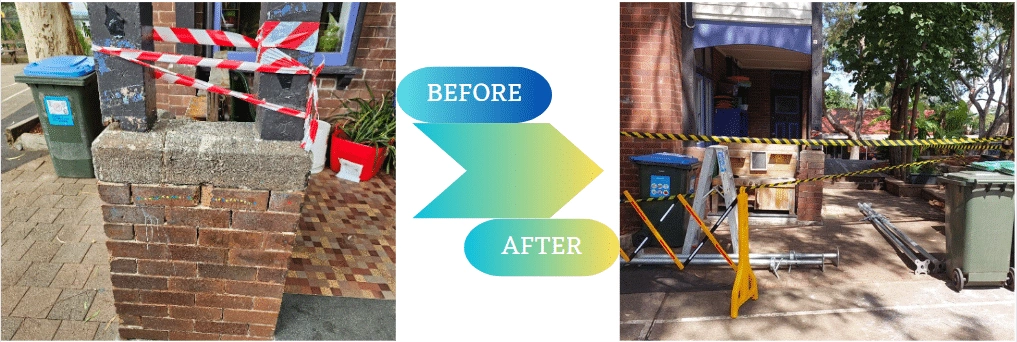
These SCE project records show temporary structural support and fire restoration in different building settings. Each case study explains the condition, construction scope and delivery approach.
An initial enquiry should distinguish the immediate risk-control scope from investigation and permanent rectification. This helps the client, insurer, owners corporation, consultants and contractor understand what is authorised now and what remains to be designed or approved.
SCE delivers emergency remedial projects across Sydney, the Hunter Region and NSW. Share the known condition, location and urgency so we can establish the response, engineering inputs, access arrangements and authorised scope.
Review Service LocationsEmergency remedial questions
Emergency remedial building works are project-specific measures used to control an urgent building condition, protect people or property and reduce further deterioration. The immediate work should be limited to the verified and authorised need while the permanent rectification pathway is defined.
Provide the site address, photographs, affected areas, incident timing, current access restrictions, known hazards, available reports or drawings, stakeholder and insurer details, and the safest site contact. Do not enter an unsafe area to collect information.
Make-safe work addresses the immediate verified risk through measures such as isolation, protection or temporary support. Permanent rectification addresses the underlying defect and may require investigation, design, approvals, procurement and further construction work.
SCE may review suitable temporary-support and make-safe scopes where the site, authority, access, evidence and project team allow controlled delivery. Engineering advice, design and certification remain with appropriately appointed practitioners where required.
SCE does not make that legal or regulatory determination for the client. Whether an exception or reasonable excuse applies should be addressed by the responsible parties with appropriately appointed practitioners, certifiers, authorities or legal advisers as relevant to the actual work.
Records may include the initial condition, photographs, instructions, authority to proceed, scope boundaries, site controls, work completed, inspections, monitoring requirements and the outstanding permanent-rectification actions. Project-specific obligations should be confirmed before work begins.
It may be possible where suitable access, exclusion zones, communication, temporary protection, emergency arrangements and stakeholder controls can be established. The occupants, operations and work area must be assessed before a programme or method is confirmed.
No. An enquiry starts a suitability review. Attendance, acceptance, price, programme and outcomes depend on the verified condition, location, access, available evidence, authority, safety requirements, project team and agreed commercial terms.
Send the site address, photographs, affected areas, incident timing, access restrictions, available reports and the responsible stakeholder details so SCE can plan the next stage of response.