NSW construction change-control guide

Latent Conditions Discovered During Construction in NSW: Evidence, Notice and Scope-Control Checklist

Unexpected ground, structure, services or hazardous materials can stop a workfront and create immediate safety, programme and commercial questions. This guide sets out a practical response sequence for latent conditions NSW construction teams can adapt to the signed contract and project controls.

General project information Contract-specific notices Updated September 2026
Quick answer

Make the affected work safe, preserve the condition as found, check the signed contract’s notice pathway, establish an authorised hold point, assess the scope/time/cost interfaces, obtain the required instruction, and close the decision record. A factual notice is evidence; it is not automatically an entitlement decision.

Start with facts

An unexpected condition is both a site event and a control event

The first response should protect people, property and evidence. Contract interpretation can follow, but the project team should not lose the physical record or allow an uncontrolled scope change while responsibility is being considered.

Important boundary: “Latent condition” is not a universal label with one automatic result. The definition, notice requirements, risk allocation and potential entitlement depend on the project’s executed contract and circumstances. This page is general construction-management information, not legal advice.

Six controlled actions

Response sequence after discovery

Use the sequence as a coordination framework. Project emergency procedures, WHS duties, authority directions and the applicable contract always take priority.

Make the workfront safe

Stop or isolate the affected activity where continuing could create risk, damage property or disturb evidence. Apply exclusion, temporary support, service isolation or environmental controls through authorised and competent people.

Record the condition as found

Capture date, time, exact location, observers, photographs, measurements, levels, material or service details, weather, nearby work, referenced drawings and the point at which the condition became apparent.

Check the notice pathway

Identify the contract clause, recipient, permitted delivery method, required information and time limit. Issue a factual notice without overstating cause, responsibility or entitlement.

Set a hold point and investigation scope

Define what work is paused, what safe temporary work may continue, who can authorise investigation, which specialist is needed and how opening-up, sampling or testing will be controlled and reinstated.

Assess every affected interface

Separate the original scope from proposed change. Record design, access, procurement, safety, temporary works, programme, cost, approvals, neighbouring work and handover-record implications.

Obtain and close the decision

Record the authorised instruction, accepted basis, outstanding qualifications and responsibility for action. Update drawings, programme, cost records, inspection points, photo register and the final closeout index.

Contract notice checklist

Build a notice from verifiable facts

The contract controls who receives the notice, how it must be delivered and when. The following fields help create a traceable factual record; they do not replace the contract or project-specific legal advice.

  • Event: what was observed, without assuming cause.
  • Location: grid, level, room, chainage, work area or marked-up drawing.
  • Timing: discovery time, affected activity and notification time.
  • Evidence: numbered photos, measurements, samples, records and witnesses.
  • Immediate controls: stop-work boundary, isolation, protection and temporary work.
  • Potential effect: affected scope, interfaces, programme and direct cost categories.
  • Requested response: inspection, information, instruction or authorised investigation.
Decision and scope control

Keep one linked condition-to-decision register

A practical register connects the discovery to the documents needed for a defensible site, programme and commercial record.

ControlMinimum recordOwner or authorityCloseout evidence
Safety and hold pointAffected boundary, immediate controls, permitted temporary workSite management and applicable WHS duty holdersRelease or revised safe-work control
Condition evidencePhotos, location, measurements, drawings, samples and chronologyNamed recorder and relevant specialistNumbered evidence set
Contract noticeCorrect clause, recipient, method, timing and stated effectsContract-authorised sender and recipientDelivery and receipt record
InvestigationAuthorised scope, access, isolation, testing and reinstatementAppointed designer, engineer or specialist as applicableReport, result and instruction
Change assessmentOriginal versus changed scope; time, cost and interface effectsContract administrator and authorised partiesWritten decision or instruction
Delivery and handoverRevised work method, inspections, as-built information and outstanding itemsConstruction team and appointed reviewersClosed register and handover index
Safety branches

Some discoveries need an immediate specialist pathway

Do not keep excavating, demolishing or opening up simply to learn more when the condition could expose people or assets to harm.

Unknown or damaged services

Stop the affected activity, secure the area, use current essential-services information and engage the relevant locator, asset owner or emergency service. SafeWork NSW requires current essential-services information before excavation work starts.

Suspected asbestos or hazardous material

Minimise disturbance, prevent access and follow the site asbestos or hazardous-material procedure. Assessment, removal and clearance must be completed by appropriately competent or licensed parties where required.

Instability, collapse or ground movement

Establish exclusion and temporary controls through competent people. The project may require structural, temporary-works or geotechnical advice before anyone enters the area or the workfront is released.

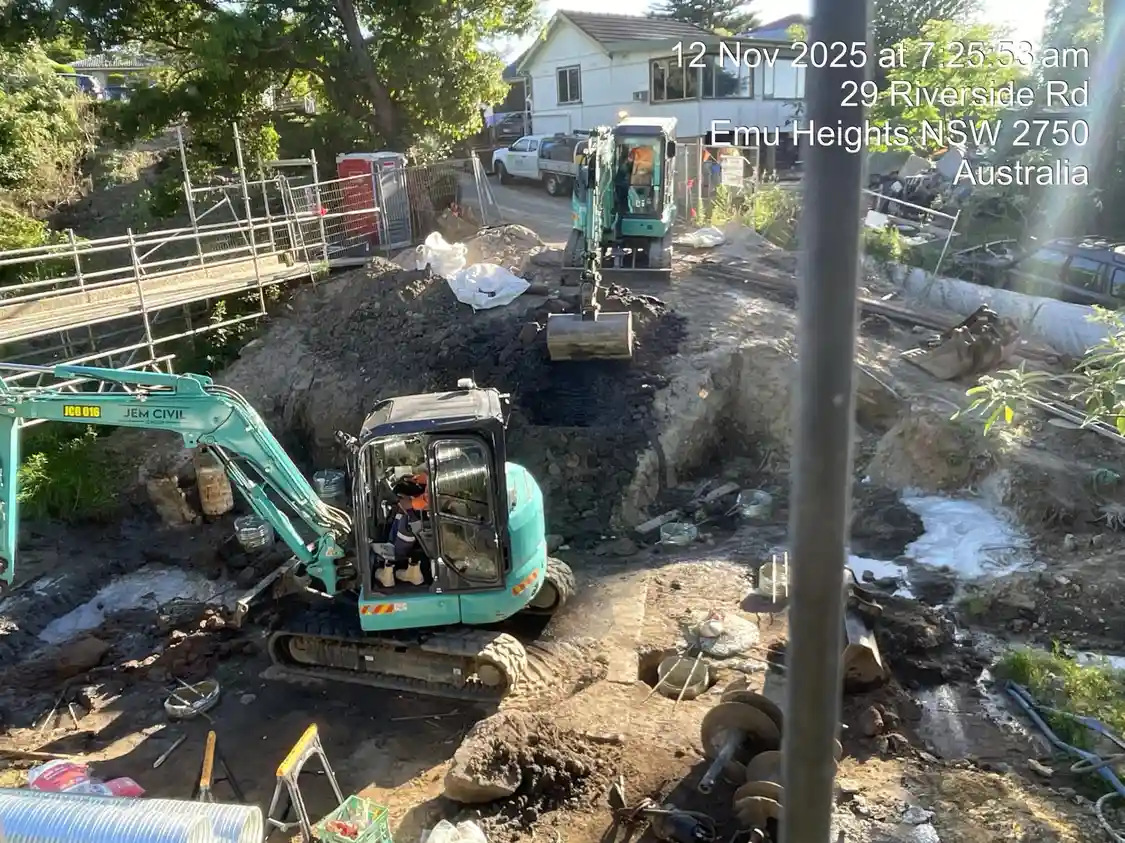
Excavators undertaking bulk excavation and foundation preparation for bridge reconstruction in Emu Heights
Completed SCE project evidence: bulk excavation and foundation preparation during the Emu Heights bridge reconstruction. It illustrates contemporaneous site-condition records; it does not state that a latent condition was found.
Evidence in context

Photographs are stronger when they are part of a record set

A useful photo register identifies the project, date, work area, direction of view, photographer and related drawing or record number. Include scale, wide context and close detail where practical, and retain the original files under the project’s document-control requirements.

SCE’s completed Emu Heights bridge reconstruction demonstrates construction delivery and coordination within a defined project. It is not presented as evidence of a contractual latent-condition claim.

Broader labelled delivery evidence is available in the Major Works Project Programme.

Programme and cost evidence

Show the effect without turning an estimate into a decision

Separate the discovery record from the later assessment. This helps the authorised contract parties understand what changed and why.

Scope comparison

Identify the original contract requirement, the physical condition found, information that was available before contract and the proposed changed work. Reference marked-up drawings rather than relying on narrative alone.

Programme effect

Record the affected activity, available resequencing, hold duration, specialist response dates, procurement lead times and any critical-path claim basis. Avoid presenting a forecast as an accepted extension of time.

Cost build-up

Separate investigation, make-safe work, temporary works, labour, plant, materials, subcontractors, delay or disruption categories and credits. Preserve dockets, timesheets, invoices and agreed rates as required by the contract.

Role boundary

SCE coordinates construction within its appointment

SCE can coordinate suitable construction activities, immediate site controls, factual record capture, authorised investigation support, trade interfaces, programme and cost evidence, and closeout documentation under the accepted scope and contract.

What remains contract-specific

Whether the event meets a defined contractual test, whether notice is compliant and whether time or cost is payable are decisions under the applicable contract. Obtain project-specific legal or contract-administration advice where needed.

What remains with appointed practitioners

Design, engineering conclusions, hazardous-material assessment, survey, certification, statutory declarations and authority acceptance remain with the appropriately appointed and authorised parties.

Learn more about SCE’s commercial construction services, the SCE System, current certifications and credentials, the broader stages of construction, and contractor roles and responsibilities.

Current NSW reference points

Check the exact contract and current official guidance

Frequently asked questions

Latent conditions in NSW construction

What is a latent condition in construction?

The meaning depends on the project’s contract and risk allocation. It commonly refers to a physical site condition that differs materially from what the contract says, shows or reasonably allows for, but the applicable definition and consequences must be checked in the signed contract.

What should happen immediately when an unexpected condition is found?

Stop or isolate the affected activity where continuing could create risk or destroy evidence. Make the area safe, notify the responsible site and contract contacts, record the condition as found, and follow the project’s WHS, emergency and incident procedures.

What should a latent-condition notice contain?

Follow the contract’s recipient, method and timing requirements. A factual notice should identify what was found, where and when it was found, who observed it, the evidence available, the affected work, immediate controls and any authorised investigation proposed. Obtain project-specific legal advice when interpretation is uncertain.

Can work proceed before the scope change is approved?

Safe temporary action or authorised investigation may need to proceed, especially where people, property or essential services are at risk. Permanent changed work should follow the contract and the authorised written instruction or approval pathway unless a genuine emergency procedure applies.

Does discovery automatically entitle the contractor to extra time or cost?

No. Entitlement depends on the contract, allocated risk, the actual condition, compliance with notice requirements, causation and supporting records. A factual discovery record is necessary evidence, but it is not itself a decision on entitlement.

Who should assess the condition?

Use the appropriately appointed person for the issue, which may include a geotechnical engineer, structural engineer, hazardous-materials specialist, surveyor, services locator, designer, certifier or authority. SCE can coordinate construction activities and records within its appointment; it does not replace those independent roles.

Discuss a defined construction scope

Need coordinated site records and change control?

Share the project location, contract stage, available drawings, site record and the condition discovered. SCE can review whether the construction and coordination scope is suitable for assessment.

Contact SCE about the project