
DBP Remedial Works NSW: A Practical Guide for Strata and Building Managers
DBP remedial works NSW can trigger Design and Building Practitioners Act obligations where the project involves a regulated building, a regulated building element, a performance solution, waterproofing, cladding, structural repairs, fire safety systems or other compliance-sensitive work.
For strata managers, owners corporations, building managers and facility teams, the practical issue is simple: before a remedial project is priced, approved or started, the project team should understand whether DBP obligations may apply and what documentation pathway may be required.
This DBP remedial works NSW guide is written for decision-makers dealing with strata remedial works DBP questions, DBP Act remedial works, cladding replacement, waterproofing defects, façade issues, structural repairs and fire-safety related remedial scopes.
SCE Corp supports DBP-aware remedial works across Sydney and NSW by combining building remediation experience, construction delivery capability, ISO-certified systems and early planning tools that help clients identify the right next step before formal scope, inspection and quotation.
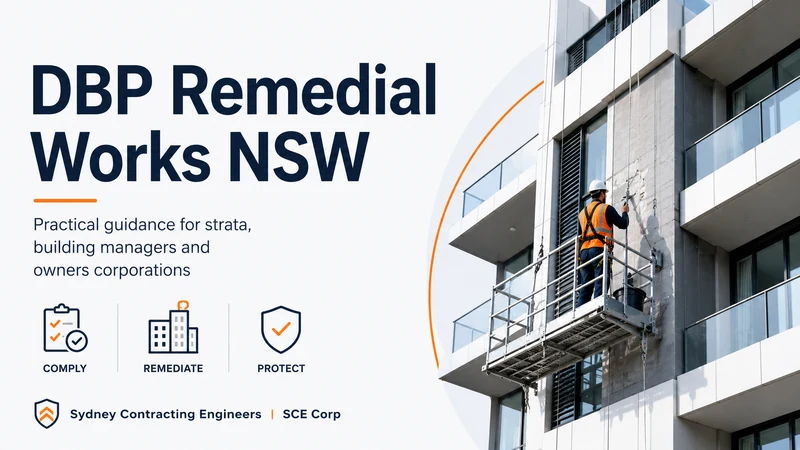
What are DBP remedial works NSW?
DBP remedial works NSW are remedial building works where the NSW Design and Building Practitioners framework may apply because of the building class, the type of work, the building element involved or the need for a performance solution.
Remedial works are not always simple repairs. They often involve investigation, diagnosis, design coordination, access planning, consultant input, staged construction and documented close-out. In strata and occupied buildings, this can include façade repairs, waterproofing replacement, cladding upgrades, structural concrete repair, fire-safety rectification, roof-system work and building-envelope repairs.
DBP Act remedial works should be considered early where the work may affect a regulated building element or where the project involves design, certification, fire safety, waterproofing, cladding, building enclosure or structural issues.
The NSW Government states that remedial building work is a broad term covering repair or upgrades on existing buildings, defect rectification or corrective action. For Class 2 buildings, including mixed-use buildings with a Class 2 part, remedial building work is regulated under DBP legislation unless excluded or treated as emergency remedial building work.
This article provides general information only. It is not legal, certification or engineering advice. Project-specific advice should be obtained from the relevant registered practitioner, certifier, engineer, consultant or legal adviser where required.
When DBP Act remedial works obligations may apply
DBP Act remedial works obligations may need to be considered where the project involves a regulated building and work to a regulated building element or performance solution. For remedial works, the key practical questions usually include:
- Is the building a Class 2 building, or a mixed-use building with a Class 2 part?
- Is the work connected to waterproofing, cladding, the building enclosure, fire safety systems, structural elements or BCA-related services?
- Is the work excluded from DBP obligations, or is that uncertain?
- Is the work urgent enough to be treated as emergency remedial building work?
- Does the scope require a Construction Issued Regulated Design?
- Will designs and declarations need to be lodged through the NSW Planning Portal?
- Are registered design practitioners and building practitioners required for the scope?
The safest commercial position is to check early. Leaving DBP review until after contractor pricing or after commencement can create programme delays, rework, consultant disputes, approval issues and cost escalation.
For DBP remedial works NSW, early review is especially important where the building is occupied, the work affects common property, or multiple consultants, contractors, strata stakeholders and building managers need to coordinate decisions.
Common remedial triggers for strata and building managers
DBP issues are common in remedial projects because the work often affects the exact building elements that the legislation is concerned with. For strata and building managers, the following scopes should be treated as compliance-sensitive until properly reviewed.
1. Waterproofing and water ingress
Waterproofing failures in roofs, balconies, podiums, basements, terraces and wet areas can move beyond a standard repair. If the work involves replacement of a waterproofing system, interface detailing, falls, drainage or membrane design, DBP review may be required.
2. Cladding and façade works
Cladding replacement, façade remediation, combustible cladding removal, façade panels, fixings, cavity barriers, weatherproofing and external-wall system changes can involve building enclosure issues. These projects often require early consultant coordination and clear demarcation between existing and new work.
3. Structural and concrete remedial work
Spalling concrete, reinforcement corrosion, cracking, structural movement, slab-edge issues, balcony repairs, retaining structures and load-bearing elements may require structural engineering review and regulated design consideration.
4. Fire safety systems and passive fire upgrades
Fire-safety related remedial works can affect BCA compliance, fire systems, penetrations, passive fire treatment, egress, doors, services and certificates. These should be reviewed carefully before works are scoped as routine maintenance.
5. Roof and building-envelope works
Roof replacement, roof membrane works, façade water ingress and building-envelope upgrades can affect waterproofing, building enclosure, structural elements and compliance sequencing. These works may also require access, scaffolding, weather protection and staged handover planning.
For a broader explanation of remedial works, building defects and the DBP Act duty of care, read SCE Corp’s related article: Remedial Works, Building Defects and the DBP Act.
Strata remedial works DBP issues
Strata remedial works DBP issues usually arise when owners corporations, strata managers and building managers need to repair common property while also managing compliance, access, safety, resident communication, design coordination and funding approval.
Common examples include façade leaks, balcony waterproofing failures, cladding replacement, fire-safety rectification, roof defects, concrete spalling, corrosion, cracking, drainage issues and recurring water ingress.
These projects are rarely just trade repairs. They often require a staged pathway involving investigation, consultant review, scope confirmation, registered practitioner input where required, contractor pricing, access planning, resident communication and documented completion records.
For strata remedial works DBP planning, the most practical first step is to identify whether the works may involve a regulated building, a regulated building element or a performance solution before committing to a contractor scope or fixed price.
BIM, digital records and DBP-aware remedial planning
BIM is not the same as DBP compliance, and it does not replace statutory obligations. However, where reliable digital records, as-built information or model-based documentation exist, they can help the project team understand the building, identify interfaces and coordinate remedial scopes more efficiently.
For remedial works, useful digital information may include:
- as-built drawings and consultant reports;
- façade, roof, waterproofing or structural inspection records;
- fire safety schedules and annual fire safety statements;
- previous remedial scope documents;
- photos, access records and defect registers;
- asset information from building managers or strata records.
Good records reduce uncertainty. Poor records increase opening-up, investigation and design coordination risk. For strata and building managers, the practical step is to gather available documents early and provide them before requesting pricing.
How SCE tools help with early DBP and remedial triage

SCE Corp’s online tools are designed to help clients make better early decisions before requesting a formal quote. They do not replace legal, engineering, certification or project-specific advice, but they help structure the first review.
For DBP remedial works NSW, this early triage can reduce uncertainty before inspection, consultant review, design coordination and formal pricing.
Use the NSW DBP Applicability Checker first
The NSW DBP Applicability Checker helps users work through early indicators such as building class, work type, building elements, performance solutions, exclusions and likely practitioner roles.
Use the Remedial Planning Tool for the next step
The Remedial Planning Tool helps identify whether the issue appears to require make-safe works, investigation, consultant review, remedial design, contractor engagement or more information before pricing.
Use the Cladding Estimator where façade or recladding works are involved
The Cladding Estimator can support early budgeting for cladding replacement, recladding and façade upgrade works, subject to inspection, access review, consultant input and final scope confirmation.
Use the Project Tools hub for the broader pathway
The Project Tools NSW page brings SCE’s estimators and planning tools together so owners, strata managers, insurers, developers and building managers can start with the correct pathway.
Practical checklist before starting DBP remedial works NSW
Before requesting quotes or approving DBP remedial works NSW, strata and building managers should assemble the following information:
- Building details: address, building class, strata plan details and whether the building includes a Class 2 part.
- Scope description: what has failed, where it is located and whether the issue is localised, recurring or widespread.
- Photos and videos: clear evidence of leaks, cracking, spalling, façade defects, cladding condition or fire-safety issues.
- Existing reports: engineer reports, defect reports, waterproofing reports, fire reports, façade reports or consultant advice.
- Available drawings: architectural, structural, fire, hydraulic, façade, roof, waterproofing or as-built drawings.
- Urgency level: whether the issue is dangerous, active, worsening, exposed to occupants or publicly accessible.
- Access constraints: scaffold, rope access, swing stage, roof access, live building conditions, tenant impacts and restricted hours.
- Approval status: whether a DA, CDC, strata approval, fire-safety review, consultant approval or DBP review may be required.
- Previous repairs: any temporary works, make-safe works, patch repairs or prior contractor attendance.
- Decision pathway: who will approve investigation, consultant engagement, contractor pricing and final works.
The more complete the information, the more reliable the early pathway becomes. Incomplete information does not stop a project from starting, but it usually means the first step should be investigation or consultant review rather than immediate fixed-price remedial works.
Why SCE Corp for DBP remedial works NSW?
SCE Corp is a Sydney-based building and civil contractor delivering remedial, cladding, roof, emergency, strata, insurance, government, commercial and civil works across NSW and selected East Coast locations.
SCE’s position in DBP remedial works NSW is practical: clients need a contractor that understands compliance-sensitive delivery, site conditions, access, safety, documentation, consultant coordination and final handover, not just labour on site.
SCE Corp’s strengths include:
- DBP-aware construction delivery;
- ISO 9001, ISO 14001 and ISO 45001 certified systems;
- building and civil capability under one contractor;
- experience with remedial, cladding, waterproofing, roof, make-safe and structural repair works;
- practical tools for early DBP, remedial and project-readiness triage;
- structured communication and documentation to support project control.
For DBP Act remedial works, SCE can assist with early scope review, remedial planning, coordination with consultants and construction delivery after the appropriate project-specific pathway is confirmed.
To discuss a remedial project, use the Contact SCE page and include the address, photos, available reports, drawings and a short summary of the issue.
FAQs about DBP remedial works NSW
1. What are DBP remedial works NSW?
DBP remedial works NSW are remedial building works where the NSW Design and Building Practitioners framework may apply because of the building class, regulated building element, performance solution, scope or compliance pathway.
2. Does DBP apply to all remedial works in NSW?
No. DBP does not automatically apply to every repair or remedial task. It depends on the building class, scope, whether regulated building elements are involved, whether exclusions apply and whether the work is emergency remedial building work.
3. What are DBP Act remedial works?
DBP Act remedial works are remedial works that may fall within the NSW Design and Building Practitioners framework because the project involves a regulated building, regulated building element or performance solution.
4. Does DBP apply to Class 2 remedial works?
DBP commonly needs to be considered for Class 2 buildings, including mixed-use buildings with a Class 2 part, where remedial work involves regulated building elements or performance solutions.
5. What is a Class 2 building?
A Class 2 building generally includes apartment buildings and some multi-unit residential buildings. Mixed-use buildings can also include a Class 2 part, which may affect how DBP obligations are considered.
6. What remedial work types commonly raise DBP issues?
Common triggers include waterproofing, cladding, façade systems, fire safety systems, structural repairs, building enclosure works, roof systems, BCA-related services and performance solutions.
7. Does waterproofing remedial work trigger DBP?
Waterproofing is a regulated building element under the DBP framework. Some waterproofing work may be excluded, but this depends on the scope and specific criteria. Waterproofing should be checked early rather than assumed to be a minor repair.
8. Does cladding replacement trigger DBP?
Cladding replacement can involve the building enclosure, fire safety, weatherproofing and façade performance. For Class 2 or mixed-use buildings, cladding works should be reviewed early for DBP, planning and consultant requirements.
9. What are common strata remedial works DBP issues?
Common strata remedial works DBP issues include façade leaks, balcony waterproofing, cladding replacement, structural repairs, fire-safety defects, roof issues and recurring common-property water ingress where regulated elements may be affected.
10. What is a Construction Issued Regulated Design?
A Construction Issued Regulated Design is a regulated design prepared with enough detail for building work to be carried out in accordance with the design and the Building Code of Australia where DBP obligations apply.
11. Who prepares regulated designs?
Regulated designs must be prepared and declared by an appropriately registered design practitioner whose registration authorises them to provide the relevant declaration for that work.
12. Who lodges DBP designs and declarations?
Depending on the project pathway, the building practitioner or an appropriate practitioner may be responsible for lodging designs and declarations through the NSW Planning Portal.
13. Are emergency remedial works treated differently?
Emergency remedial building work can be treated differently in limited circumstances. However, urgency should not be used casually to avoid proper planning or documentation. Once immediate risk is controlled, the project pathway should still be reviewed.
14. Should a strata manager get a contractor quote before DBP review?
A budget discussion may be useful, but formal pricing can be unreliable if the DBP pathway, design requirements, access method, consultant input and scope are not yet clear.
15. What documents should building managers collect first?
Building managers should collect photos, reports, drawings, fire safety information, previous repair records, strata approvals, access constraints and any available as-built or BIM-related records before requesting contractor pricing.
16. Can BIM help with DBP remedial works?
BIM does not replace DBP obligations, but good digital records, models and as-built information can help consultants and contractors understand existing conditions, interfaces and remedial sequencing.
17. How can SCE’s DBP Applicability Checker help?
SCE’s NSW DBP Applicability Checker helps users work through early indicators such as building class, work type, regulated elements, performance solutions, exclusions and likely practitioner roles before seeking project-specific advice.
18. How can SCE’s Remedial Planning Tool help?
The Remedial Planning Tool helps identify whether the likely next step is make-safe works, investigation, consultant review, remedial design, contractor engagement or more information before pricing.
19. Is SCE’s online tool a legal or engineering opinion?
No. SCE’s tools provide early guidance only. They do not replace legal advice, engineering review, certification advice, authority advice, site inspection or formal scope confirmation.
20. When should I contact SCE?
Contact SCE when you have a remedial issue involving leaks, cladding, façade defects, cracking, spalling, corrosion, fire-safety issues, structural concerns, make-safe urgency or DBP-sensitive building works.