
Commercial and strata decision guide
Roof Repair or Replacement? A Guide for Commercial Buildings
The choice between roof repair and replacement should follow evidence about condition, failure mechanism, extent, access, disruption and lifecycle needs. Age or a single leak does not decide the answer. For scope, evidence and completion controls, see roofing works planning and handover.
This guide supports early planning for commercial and strata buildings. It does not replace inspection, issued design, engineering, waterproofing advice, certification or project-specific approvals.
Start with condition and cause
Gather the roof type, approximate age, drawings, maintenance history, leak records, previous repairs and storm or insurance information. Map where symptoms occur and when they appear. Water may travel across insulation, framing or roof spaces, so an internal stain does not necessarily identify the entry point.
Localised defect
One defined failed flashing, penetration, sheet, tile or membrane area with a serviceable surrounding system.
Systemic deterioration
Repeated leaks, widespread corrosion, failed laps or joints, poor drainage, brittle materials or many past repairs.
Interface problem
Defects involving gutters, outlets, walls, plant, penetrations, structure, cladding or movement rather than the covering alone.
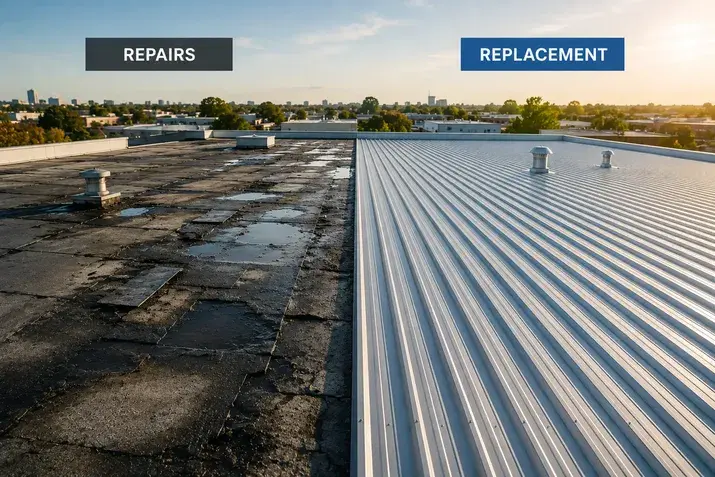
Repair, staged remediation or replacement
| Pathway | May be appropriate when | Questions to resolve |
|---|---|---|
| Targeted repair | The defect is localised, the cause is understood and surrounding materials remain serviceable. | How will the repair integrate with existing materials, drainage, movement and warranties? |
| Staged remediation | Several priority areas need work but full replacement is not yet justified or must be sequenced. | How are stages prioritised, made weather-tight and coordinated with the future system? |
| Replacement | Deterioration is widespread, repeated repairs have failed, interfaces need redesign or planned upgrades require a new system. | What substrate, structure, drainage, insulation, access, plant and temporary-weather controls are included? |
The decision should state its assumptions. If access or opening-up is limited, identify what will be verified during the work and who can approve a change.
Inspection and investigation
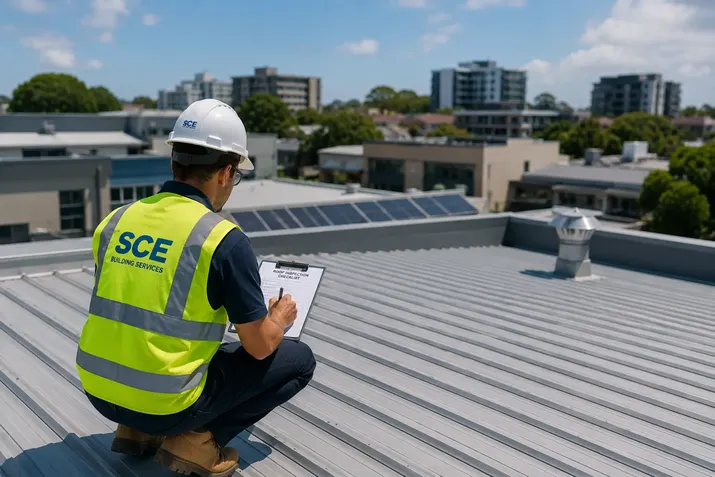
A safe roof inspection may review coverings, seams, laps, flashings, penetrations, gutters, outlets, membranes, drainage falls, corrosion, fixings and evidence below the roof. Depending on the system, competent advisers may use moisture investigation, controlled testing, material sampling or structural assessment.
Access planning matters. Fragile surfaces, skylights, edges, plant, asbestos-containing material and occupied areas may require specialist controls. Temporary access does not automatically become an acceptable permanent maintenance solution.
Scope the whole roof system
A replacement scope may involve removal, substrate or framing review, new coverings, membranes, flashings, gutters, outlets, penetrations, insulation, ventilation, plant interfaces, access systems, lightning protection or solar equipment. A repair scope should still describe preparation, compatible materials, weather protection, inspections and the acceptance standard.
For transactional roof design and replacement enquiries, use the roof replacement service pathway. For early budget scenarios, use the Roof Replacement Estimator; its output is not a quotation.
Occupied-building and weather planning
Commercial and strata buildings may need to remain operational. Plan noisy work, deliveries, exclusion zones, internal protection, shutdowns, tenant communication and emergency response. The sequence should minimise the area exposed at one time and define temporary weather protection, forecast triggers and what happens if rain occurs before the system is closed.
Plant and services may need temporary support, isolation or relocation. Responsibilities for solar panels, mechanical units, communications and roof access should be agreed before tender.
Lifecycle cost and procurement
Compare more than the initial price. Consider expected maintenance, access cost, disruption, energy or insulation implications, compatibility with planned plant, remaining serviceable areas and the risk of repeated reactive work. These inputs are building-specific; no repair life or financial return should be promised without evidence.
Quality assurance and handover
Hold points may include substrate inspection, framing or deck review, drainage falls, membrane or sheet installation, seams, penetrations, flashings and tests before work is concealed. Handover can include photographs, product and batch information, inspection or test records, approved variations, as-builts, warranties and a maintenance schedule.
Frequently asked questions
Is a leak enough reason to replace a roof?
No. The cause, extent and surrounding condition must be assessed. A local defect may be repairable; repeated or systemic failure may support a broader pathway.
When is targeted repair suitable?
It may suit an understood local defect where surrounding materials and interfaces remain serviceable and the repair has a clear acceptance standard.
When should staged remediation be considered?
Staging may help prioritise risk or manage access and budgets, but each stage must integrate with the future roof and remain weather-tight.
Does replacement include gutters and insulation?
Only if the scope says so. Coverings, drainage, substrate, insulation, plant, access and other interfaces should be expressly included or excluded.
Can work continue while the building is occupied?
Often, with suitable separation, communication, weather protection and service planning. Feasibility depends on the building and scope.
How should quotes be compared?
Compare the same surveyed areas, materials, access, temporary works, testing, interface responsibilities, exclusions and handover requirements.
What should I send SCE Corp?
Send the address, roof type, leak history, photos, reports, drawings, access information, previous repair records and intended timing.
Related pathways
Review Building Remedial Services for wider defect work and Structural and Remedial Projects for relevant proof.
Discuss the roof evidence first
Provide the available condition information so the appropriate inspection and scope pathway can be discussed.