
By Sydney Contracting Engineers (SCE Corp) · Information checked 6 October 2026
Concrete crack injection and flexible joint repair are not interchangeable ways to hide a line in concrete. A crack may require investigation into movement, loading, moisture or deterioration. A designed joint may need to continue accommodating movement. The repair objective must be clear before a material is selected.
Ask the appointed engineer or remedial designer to establish what the feature is, why it exists and what the repair needs to achieve. A photograph or crack-width measurement alone cannot determine the correct treatment or confirm structural adequacy.
Identify a crack, construction joint or movement joint
Review drawings, location, geometry and previous repairs. Record whether the feature crosses a structural element, follows a construction interface or forms part of a deliberate movement arrangement. Where the classification is uncertain, make that an investigation question rather than a tender assumption.
For a confirmed movement-joint project, SCE’s expansion-joint repair planning guide covers the broader scope, access and handover pathway.
Define the intended result
Water sealing, restoring a specified structural function and accommodating movement are different objectives. Some defects involve more than one. The scope should explain the intended performance and how it will be assessed after the repair.
Sika’s injection-selection guidance distinguishes flexible water-sealing applications from rigid structural-bonding applications. It also separates moving joints from non-moving interfaces. Product suitability still depends on the actual substrate, condition and approved repair design.
Understand movement and water conditions
Record the observed location, length, orientation, history and whether the condition changes with loading, temperature, weather or time. The appointed team should decide whether monitoring, testing or opening-up is needed and define the method and interpretation.
Identify whether the area is dry, damp or actively leaking and what is known about the source and pressure of water. Do not infer a stable crack because it happened to be dry on inspection day. Equally, a wet line does not establish that every component of the joint needs replacement.
Write a selection brief before choosing a product
- The identified defect or joint type and location.
- The required structural, movement or water-management outcome.
- The condition evidence and unresolved questions.
- The proposed preparation, system and installation limits.
- Access, occupation and temporary protection requirements.
- The inspections, tests and records needed for acceptance.
Ask the designer to identify incompatible approaches and the reason for the selected method. Do not fill a movement joint with a rigid repair merely because a neighbouring crack received that treatment. Do not describe every injected material as a structural repair.
Use the remedial planning tool to organise the condition evidence and questions for the appointed project team.
Include connected work in the quotation
The complete scope may include access, removal of previous repairs, preparation, temporary water management, protection, reinstatement and follow-up inspection. Define those items alongside the repair material. An injection rate alone may omit a substantial part of the actual work.
If investigations reveal a different condition, hold the affected work for review. Record revised instructions and the impact on quantities, programme and adjacent finishes before proceeding.
Agree how completion will be assessed
Set acceptance criteria before installation. Depending on the objective, the project team may require specified inspection, testing, monitoring or a documented follow-up period. Avoid declaring success solely because the visible surface looks neat immediately afterwards.
Retain the location record, approved method, product information, installation evidence and any exclusions. If further movement or leakage is observed, those records help the team assess whether the original assumptions remain valid.
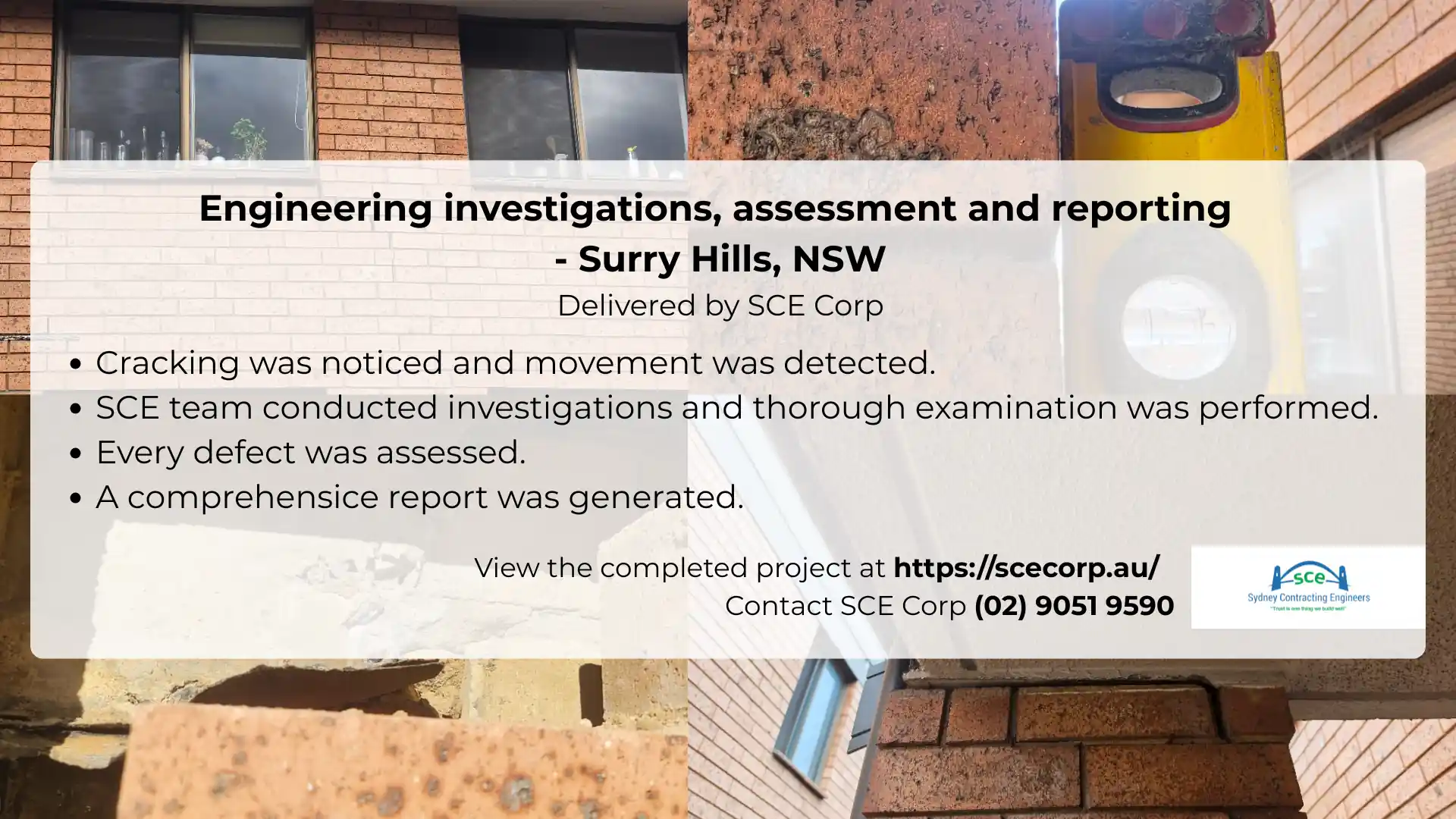
SCE’s Surry Hills project records structural assessment, remedial specification, engineering inspection reporting, remediation design and tender management with specialist consultants. SCE’s wider engineering, design and construction capability supports a defined remedial appointment, with independent certification and statutory functions allocated appropriately.
Request a Project Suitability Review with the drawings, photographs, water history and previous repair records.
Frequently asked questions
Does crack injection always restore structural strength?
No. Injection systems can serve different purposes, including water sealing or a specified structural function. The design and product selection must establish the intended outcome.
Can a movement joint be filled with a rigid repair?
Do not assume that is suitable. The required movement must be assessed and preserved through the approved joint design.
Is crack width enough to select an injection material?
No. The feature’s function, movement, substrate, water conditions and repair objective also need assessment.
What proves a concrete repair is complete?
Use the project’s agreed inspection, testing, monitoring and documentation criteria. Surface appearance alone does not establish every required performance outcome.