NSW bulk earthworks planning

Bulk Earthworks Planning in NSW: A Pre-Construction Checklist

Bulk earthworks can set the levels, access and material logic for the rest of a civil project. The useful planning question is not simply which plant will move the ground. It is whether the issued information, quantities, material decisions, services, controls, hold points and completion evidence are aligned before mobilisation.

This checklist helps owners, developers, consultants and delivery teams identify the inputs that should be resolved for a project-specific bulk earthworks scope in New South Wales. It is general decision support, not a substitute for the project’s design, approvals, WHS arrangements or specialist advice.

The practical principle

Mobilise against controlled information, not an untested volume. Every material quantity should connect to a survey basis, design surface, stated assumptions, destination, inspection requirement and person authorised to resolve change.

Define the work package

Set the Boundary Between Bulk and Detailed Excavation

Bulk earthworks generally establishes the broad site profile: stripping, cut, fill, platforms, batters, haul routes and formation levels. Detailed excavation forms tighter local elements such as footings, service trenches, pits, edges and interfaces. A project may need both, but the hand-off must be visible in the design, quantities, survey control and construction sequence.

Bulk earthworks

Broad Levels and Material Movement

  • Existing-surface preparation and stripping assumptions
  • Large-volume cut, fill, import, export and stockpiling
  • Platforms, batters, access and broad formation levels
  • Layer placement, moisture conditioning and compaction to the specified criteria
Detailed excavation

Local Features and Interfaces

  • Footings, beams, pits, trenches and local set-downs
  • Service crossings, penetrations and congested zones
  • Close-tolerance trimming around structures and boundaries
  • Local support, access and inspection requirements

Scope-control prompt: state who supplies survey set-out, who confirms founding or formation acceptance, what tolerances apply, where bulk work stops, where detailed work starts, and how a changed condition is recorded and authorised.

For SCE’s commercial delivery scope, visit the protected Bulk Earthworks Services NSW owner. This article retains only the pre-construction planning and readiness role.

Pre-construction readiness

Nine Checks Before Bulk Earthworks Mobilisation

The order may change to suit the project, but each topic should have a current input, an accountable decision-maker and a documented hold point where uncertainty remains.

Confirm the planning and approval basis

Identify the applicable development pathway, consent conditions, approved plans, environmental requirements, permits and authority interfaces. Confirm whether the earthworks shown are approved and whether staged or early works are separately authorised.

Decision record: applicable pathway, approved document set, conditions register and unresolved approvals.

Lock the survey datum, models and design issue

Confirm the existing-surface survey, boundaries, benchmarks, coordinate system, design surface and the revision authorised for construction. Clarify stripping depths, topsoil, batter geometry, pavement or slab build-ups, tolerances and exclusions before quantities are treated as reliable.

Hold point: survey/design discrepancy or an incomplete model changes the measured volume.

Understand the ground and environmental constraints

Review available geotechnical, contamination, acid sulfate soil, groundwater and other environmental information with the appropriately appointed specialists. Identify assumptions about rock, unsuitable material, proof-rolling, treatment, testing frequency and wet-weather response.

Hold point: unexpected material, water, odour, staining, buried objects or different ground behaviour.

Locate services and protect adjoining assets

Obtain current essential-services information, reconcile it with site investigation and make the information available to those doing the work. Plan for overhead and underground assets, boundary conditions, adjacent structures, retained roads and any monitoring or exclusion requirements.

Hold point: a service, obstruction or adjoining condition conflicts with the intended cut or plant movement.

Balance cut, fill, import, reuse and export

Connect each quantity to its survey/design basis and stated factors for stripping, bulking or shrinkage, unsuitable material, treatment and tolerances. Define whether excavated material is proposed for reuse, stockpiling, off-site movement or disposal—and what evidence is needed before that route is accepted.

Control: quantity reconciliation by material type and destination, not one undifferentiated total.

Plan water, erosion and sediment controls

Coordinate the construction-stage erosion and sediment control approach with clearing limits, temporary drainage, clean-water diversion, stabilised access, stockpile locations, dewatering assumptions and progressive stabilisation. Sequence controls so exposed ground is not created before the relevant measures are ready.

Hold point: forecast or actual conditions exceed the agreed water-management controls.

Test access, plant, haulage and staging

Check whether gates, haul roads, turning areas, loading zones, overhead clearances and temporary platforms suit the proposed plant and vehicles. Separate people from mobile plant and coordinate deliveries, public-road interfaces, neighbouring uses, working hours, dust, noise and cleaning.

Control: a buildable staging plan that works with the site’s actual access and operating constraints.

Complete project-specific safety planning

Identify excavation and mobile-plant hazards, work near services, fall or collapse exposure, ground stability, spotter and exclusion arrangements, emergency response and any high risk construction work. Required SWMS and other controls must be prepared by the relevant duty holders for the actual method and site.

Stop rule: do not proceed where required information, controls, competency or authority is absent.

Agree inspection, testing and completion evidence

Define survey checks, layer records, test locations and frequency, proof-rolling or inspection requirements, nonconformance handling, photographs, imported-material records, dockets, as-built information and release criteria. State who witnesses, reviews and accepts each hold point within their appointed role.

Output: traceable records that connect the finished formation to the controlling design and agreed quality process.

Price and programme clarity

Inputs That Commonly Change the Earthworks Plan

A lump quantity is only as useful as its basis. The table identifies information that can materially change plant selection, sequencing, material routes, testing or the time required to reach an accepted formation.

Bulk earthworks inputs, planning questions and possible project effects
InputQuestion to resolvePossible effect if unresolved
Survey and design surfacesAre the existing and proposed surfaces complete, coordinated and on the same datum?Volume changes, rework, disputed quantities or incorrect formation levels.
Material behaviourWhat ground types, rock, moisture conditions or unsuitable zones are reasonably evidenced?Different excavation, treatment, haulage, placement, testing or temporary works.
Cut–fill balanceWhich material is suitable for which location, and what allowances apply?Unexpected import, export, stockpiling or double handling.
Waste and environmental statusWhat classification, testing, tracking, destination or approval applies?Unavailable destinations, rejected loads, delay or unlawful handling risk.
Services and adjoining assetsWhere are confirmed services, protection zones and sensitive interfaces?Changed methods, restricted plant, hand excavation, support or monitoring.
Water and weatherHow will clean water, dirty water, groundwater and exposed soil be managed?Lost production, damaged formation, sediment release or remediation work.
Access and haul routeCan the planned fleet enter, turn, load and leave without unsafe conflicts?Smaller plant, lower cycle efficiency, traffic changes or staged operations.
Inspection and releaseWho checks each layer or formation, against what criterion, and when?Covered work, repeat testing, delayed follow-on trades or incomplete records.

Better comparison: when reviewing earthworks proposals, compare the survey/design basis, included material classes and routes, testing, working hours, access, temporary controls, exclusions and change process—not only the headline volume or plant list.

Material accountability

Plan Every Material Route and Its Evidence

Proposed On-Site Reuse

State the intended engineering use, suitability criteria, processing or moisture assumptions, placement zone, testing and person authorised to confirm acceptance. Reuse for construction performance and environmental or waste status are separate questions.

Imported Fill

Define the specification, source controls, delivery records, inspection, test evidence and reconciliation to placed quantities. Do not leave acceptance criteria until trucks are at the gate.

Surplus or Unsuitable Material

Identify classification responsibility, stockpile controls, authorised transport and destination, docket reconciliation and the response if actual material differs from the assumed classification.

The NSW EPA’s Waste Classification Guidelines set out a step-by-step process for classifying waste and include a separate part for acid sulfate soils. Classification does not itself establish whether a material is suitable for a proposed engineering use. Keep the environmental/waste decision and the design/geotechnical suitability decision explicit.

During delivery, maintain a quantity and destination record that can be reconciled with survey progress, imported-material evidence, off-site dockets and approved changes. The later NSW civil WAE and handover checklist explains how construction records can support closeout without replacing survey, design, certification or authority functions.

For construction-phase water controls, the NSW “Blue Book” supports councils and industry with soil-erosion and sediment-control guidance. SCE’s separate erosion-control guide retains that detailed topic; this checklist only makes it a mobilisation dependency.

Safe, accountable delivery

Keep Safety, Design and Acceptance Roles Clear

SafeWork NSW treats excavation as construction work and directs projects to check essential services before excavation. It also identifies high risk construction work triggers relevant to excavations and mobile plant. These requirements are not completed by a general checklist: the duty holders must apply them to the actual site, method and workforce.

Typical bulk earthworks roles and boundaries
Party or functionTypical planning contributionBoundary to preserve
Client, principal or developerProject objectives, land/access authority, approvals, programme priorities, records and decisions.Confirms governance and appoints the necessary competent parties; does not transfer statutory duties by assumption.
Designer or engineerDesign surfaces, geometry, performance criteria, details, tolerances and responses to design issues.Engineering and design decisions remain with the appropriately appointed practitioner.
Survey, geotechnical and environmental specialistsSurvey control, ground interpretation, testing strategies, contamination or waste advice within the appointment.Specialist interpretation, classification and certification are not contractor claims.
Principal contractor and earthworks contractorBuildability, method, staging, plant, supervision, agreed controls, quality records and change notification.Implements the controlled scope and escalates departures; does not self-approve design or statutory outcomes.
Certifier, consent authority or asset ownerPerforms the separate review, approval, inspection or acceptance function required by the pathway.Authority acceptance is not implied by construction completion or record delivery.
Role boundary

SCE’s Position in the Project Team

SCE may contribute civil-construction planning, constructability, sequencing, coordinated delivery, inspection/test records and handover support within an agreed appointment. Survey, engineering and design, geotechnical or environmental interpretation, waste classification, regulated WHS duties, certification, development approval and authority acceptance remain with the appropriately appointed or duty-holding parties.

For the connected service family, see SCE’s Earthworks, Concreting and Underground Services hub.

Bounded SCE project evidence

Emu Heights Bridge Reconstruction

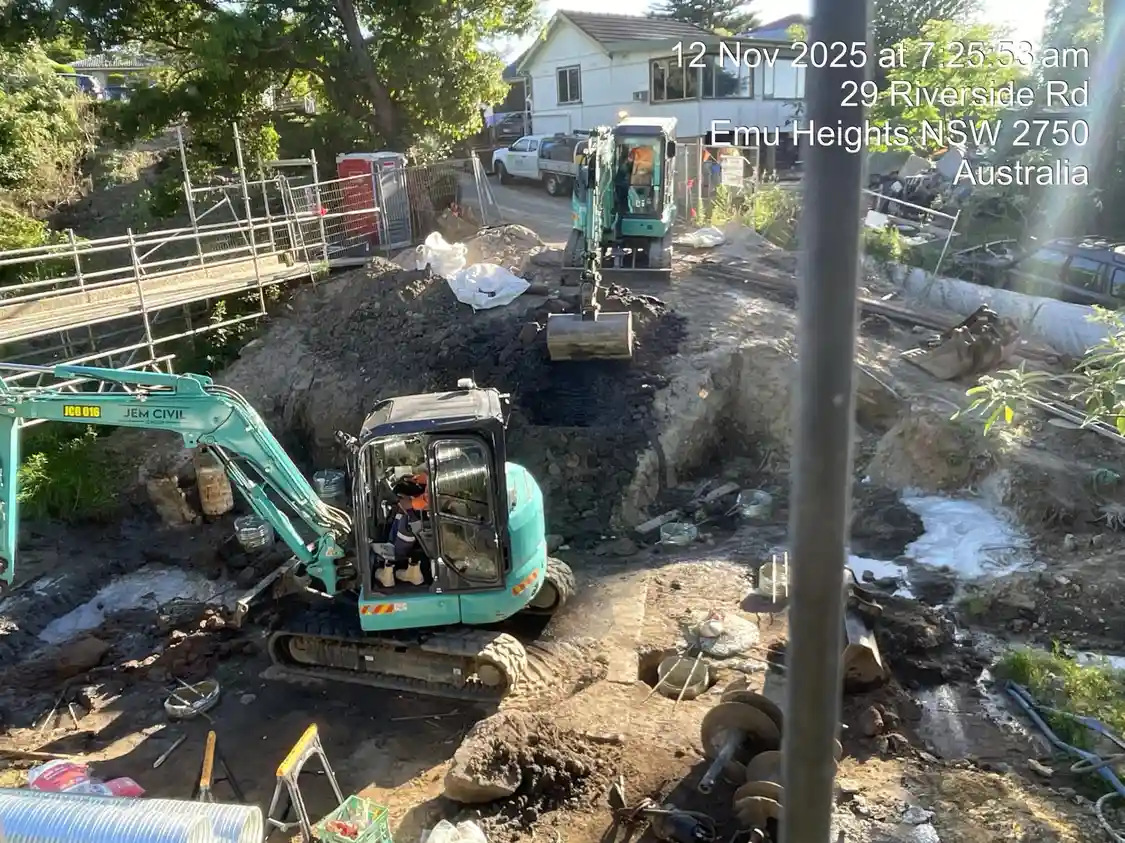
The image below records excavation and foundation preparation during SCE’s completed bridge reconstruction project at Emu Heights, NSW. It demonstrates work on that project only. It does not establish a universal excavation method, quantity, ground condition or result for another site.

Excavators undertaking bulk excavation and foundation preparation for bridge reconstruction in Emu Heights
Completed SCE project evidence: excavation and foundation preparation at Emu Heights. View the bounded project record.
Prepare a useful enquiry

What to Include in an Early Bulk Earthworks Scope Pack

A clear early pack lets the delivery team identify gaps before those gaps become site assumptions. Include what is available and label what is still preliminary.

Site and Design Information

  • Site address, boundaries, access points and neighbouring interfaces
  • Current planning pathway, consent conditions and issued plans
  • Existing and proposed survey surfaces, datum and model revision
  • Geotechnical, contamination, acid sulfate soil and groundwater information
  • Current underground and overhead services information

Delivery and Record Requirements

  • Cut, fill, stripping, import, reuse, export and rock assumptions
  • Material specifications, proposed sources and destinations
  • Erosion/sediment, water, access, traffic and operating constraints
  • Programme, staging, working hours and follow-on trade interfaces
  • Testing, survey, hold-point, change-control and handover requirements

If information is missing: identify the gap, the party responsible for resolving it, the assumption currently being used and the decision date. An explicit provisional allowance is more controllable than a silent assumption.

Frequently asked questions

Bulk Earthworks Planning FAQs

What is bulk earthworks?

Bulk earthworks is the large-scale excavation, placement and shaping of soil or rock used to establish the main site levels, platforms, batters and broad formation before more precise construction proceeds. The exact scope is project-specific and should be read with the issued design, approvals and ground information.

What should be resolved before bulk earthworks start?

The project team should resolve the applicable approval pathway, issued design information, survey control, ground and environmental evidence, known services, cut-and-fill assumptions, material destinations, water and erosion controls, access and traffic arrangements, safety planning, inspection points and required completion records. The responsible practitioners and duty holders should confirm the requirements for the actual site.

What is the difference between bulk and detailed excavation?

Bulk excavation establishes the broad earthworks profile and moves larger volumes. Detailed excavation forms local trenches, footings, pits, service interfaces and other tighter features to the required dimensions and tolerances. The boundary should be stated in the scope so quantities, plant, survey and handover responsibilities are not assumed.

How are cut-and-fill quantities checked?

Quantities are commonly developed by comparing an existing-surface survey or model with the issued design surface, then applying agreed assumptions for stripping, bulking or shrinkage, unsuitable material, imported fill and tolerances. A suitably appointed surveyor or designer should establish the controlling information, and the construction team should record progress and departures from it.

Can excavated material be reused on site?

On-site reuse should not be assumed. The material must be suitable for the proposed engineering purpose and managed consistently with the applicable design, environmental, contamination, waste and approval requirements. Testing, classification or specialist advice may be needed, and unsuitable or surplus material requires an authorised destination and records.

When is a SWMS required for excavation work in NSW?

A Safe Work Method Statement is required before high risk construction work starts. SafeWork NSW lists excavation-related triggers that include work in or near a shaft, a trench deeper than 1.5 metres, moving powered mobile plant, pressurised gas mains or piping, energised electrical services, a risk of a person falling more than 2 metres, or likely asbestos disturbance. The relevant duty holder must determine the site-specific requirements.

Current primary guidance

Useful NSW Sources

Primary-source links were checked on 3 September 2026. Requirements can change and depend on the land, proposal, work method and approval pathway. Confirm the current requirements for the actual project.

Early civil scope review

Planning Bulk Earthworks for a NSW Project?

Send SCE the site address, issued plans, survey, available geotechnical and environmental information, approvals, cut/fill or spoil assumptions, known services, access constraints and programme. We can review the civil-construction scope and identify delivery questions within SCE’s appointed role.

Contact SCE about the project

Last reviewed: 3 September 2026. General information only; obtain project-specific advice, design, approvals and certification from the appropriate practitioners and authorities.