
By Sydney Contracting Engineers (SCE Corp) · Information checked 5 November 2026
Cladding corrosion can involve the visible panel, a fixing, a flashing or a concealed support. A stain on the surface does not identify which component is deteriorating or establish the remaining capacity of the assembly. The investigation should locate the affected parts and explain the mechanism before a repair method is selected.
If panels, fixings or other façade elements may be loose, keep people clear of the affected area and arrange prompt competent assessment. Do not disturb suspect components to obtain a closer photograph. The responsible team must determine any access restrictions or temporary controls.
Map the extent and pattern of corrosion
Map affected elevations and note the height, orientation and location of staining or deterioration. Record whether it occurs around fasteners, cut edges, joints, ledges, penetrations or adjoining materials. Include dated photographs taken from a safe position and any history of leaks or earlier repairs.
A repeated pattern may help the investigation distinguish an isolated damaged coating from a wider compatibility, wetting or installation issue. It does not prove the cause. SCE’s cladding warning-sign guide covers the initial condition record and escalation questions.
Identify the components actually installed
Gather specifications, product records, drawings and previous inspection reports. Ask which parts are verified and which are only assumed. The visible panel material may be known while fastener grade, subframe coating or concealed flashing remains undocumented.
- Outer panel or board and its protective finish.
- Fasteners, brackets and washers.
- Subframe or supporting members.
- Flashings, trims and adjacent metalwork.
- Interfaces where water can collect or flow between materials.
Where access or opening-up is needed, define a safe investigation method and reinstatement scope. The sample locations should answer a stated question rather than being chosen only because they are convenient to reach.
Check moisture and material compatibility together
Ask the appointed team to consider exposure, coating condition, trapped moisture, drainage and material combinations. BlueScope’s technical bulletin explains that dissimilar-metal contact and runoff can create compatibility concerns. Those mechanisms need assessment against the actual installed components.
Rondo’s discussion of top-hat corrosion also highlights why concealed supports deserve attention. A surface coating repair cannot be assumed to restore a deteriorated support or fixing connection.
Require a defined repair boundary
The resulting scope should state which components remain, which require treatment and which require replacement. Ask what evidence supports each decision and whether the extent needs further investigation. Where structural performance is involved, the appropriately appointed engineer should define the required response.
A replacement fastener should not be selected solely because it looks more corrosion resistant. Confirm its compatibility, capacity, installation requirements and relationship to the retained assembly through the design and product requirements. Do not treat a generic online material table as the specification for the building.
Can a new rail layout reuse existing vertical supports?
SCE separates structural capacity from fixing geometry. Our engineering team reviews the existing members and their connections to the building against the replacement system’s loads. Member dimensions, age, corrosion and other damage matter. Sections that cannot be demonstrated to be suitable are replaced or rectified through the design before new panels conceal them.
Where the retained vertical supports and connections are verified as suitable, designed horizontal rails can create the fixing positions needed by the new cladding. This can reduce the need to install additional vertical supports with new connections into the building. The secondary rails also add weight and façade depth, so their members, connections and effect on the retained structure form part of the engineering assessment.
A wider fixing surface or closer fixing spacing does not, by itself, restore a weakened support. SCE coordinates the selected rail arrangement with membranes, drainage, ventilation and adjoining details. Our façade inspection and assessment pathway helps establish the evidence needed before a repair or replacement scope is settled.
Plan the work and its verification
Include access, removal, temporary support where required, occupied-area protection and weather management in the repair scope. State the inspection points before the affected work is concealed. Keep records identifying installed products, treatment areas, substitutions, inspections and any unresolved conditions.
At handover, explain maintenance requirements and how the owner can arrange future access. If some parts were not opened or assessed, state that limitation clearly. A photograph of a repainted panel should not be presented as evidence that every concealed component has been examined.
Connect investigation to delivery
What did the Belmont replacement reveal behind the panels?
On the Belmont recladding project, moving from bonded composite sheets to folded solid aluminium required changes to the supporting construction. SCE also addressed corroded components exposed during the works and adjusted side details to suit the revised façade depth. The work also included replacing existing drainage pipes and considering moisture escape behind the cladding, rather than covering up those interfaces with new panels.
The team separately raised a fixing query through the project’s design-review process. The revised detail used larger screws where possible, or an additional member behind the structure where larger screws were unavailable. These were project-specific construction responses, not a standard repair detail for every corroded façade.
For another building, the useful starting point is a clear record of what can remain, what needs treatment and what must be replaced before the new panels conceal the work.
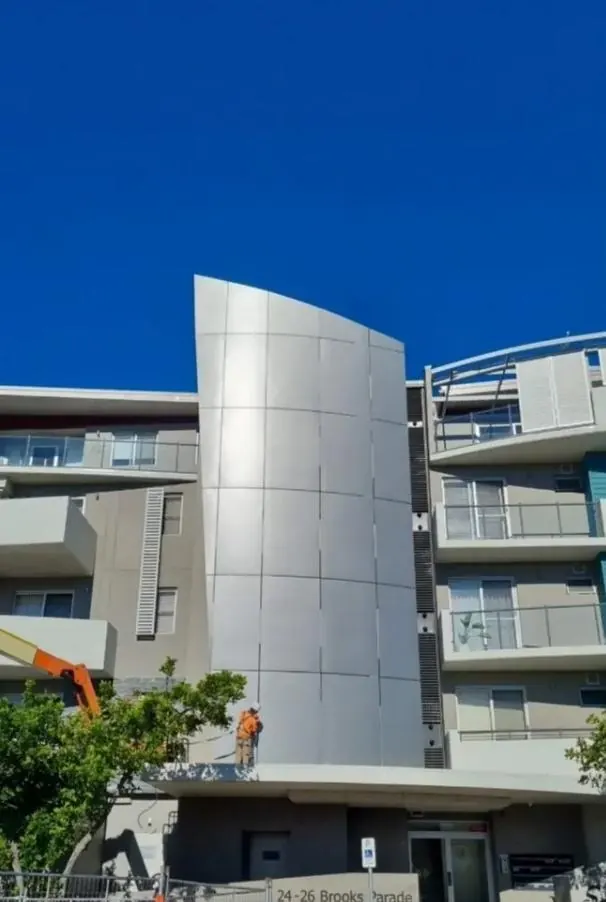
SCE’s façade portfolio provides documented examples of replacement work, installation and quality records. SCE delivers investigation, engineering and design, procurement, construction, testing and handover as a coordinated package, with specialist and independent certification responsibilities defined for the project.
Request a Project Suitability Review with the location, safe photographs, available material records, inspection history and known access constraints.
Our cladding defect and maintenance questions connect fixing investigations with material selection, repair scope and handover requirements.
Frequently asked questions
Does rust staining prove the cladding panel is corroding?
No. Staining may originate from a fixing, support or adjoining material. The investigation should identify the source and affected components.
Can corroded fixings simply be painted?
That cannot be decided from appearance alone. The team must establish the component’s condition, function and required repair or replacement response.
Should every fixing be replaced with stainless steel?
Do not make a blanket substitution. The selected fastener must suit the complete assembly, exposure, capacity and product requirements.
What should a corrosion repair handover include?
Identify treated and replaced components, product records, inspections, approved changes, maintenance requirements and any areas that were not assessed.