1. Scope and information status
Identify the activity, the accepted information for that activity and any exclusions or outstanding decisions. Preliminary or superseded documents should not be treated as construction-ready.

Sydney construction delivery guide
Civil engineering information supports construction when it is connected to the actual site, sequence of work and project responsibilities. This guide explains practical delivery interfaces without treating construction coordination as a substitute for separately appointed design, certification or registered-practitioner roles.
Civil Engineering Project Planning
Construction decisions may rely on drawings, specifications, reports, survey information, authority requirements, inspection plans and written responses. The useful question is not simply whether information exists, but whether the current information is accepted for the proposed activity and coordinated with site conditions.
Explore SCE's Engineering Services and Engineering Design capabilities for the technical disciplines needed on your project. Here, the focus is how those inputs shape the work on site.
Four delivery interfaces
Identify the activity, the accepted information for that activity and any exclusions or outstanding decisions. Preliminary or superseded documents should not be treated as construction-ready.
Compare the available information with levels, access, existing structures, underground services, neighbouring assets, water movement and temporary controls.
Plan how excavation, drainage, concrete, structures, services, remediation and access activities interact. Dependencies and hold points should be understood before work is covered or becomes inaccessible.
Record site discoveries, queries, responses, accepted revisions, inspections and completion evidence. A controlled record helps the project team understand what changed and which activities were affected.
Before ordering a precast element, fixing a foundation position or committing to an excavation sequence, connect the design decision to surveyed levels, verified service positions, delivery and lifting access, temporary support and water management. Confirm who resolves any mismatch and when that decision is needed. A technically suitable component can still be impractical to install if the access or preceding work has not been considered.
SCE delivers integrated construction and engineering services, including design-and-construct and EPC delivery supported by established multidisciplinary engineering relationships. The delivery plan identifies who designs each element, how design decisions reach the site team and which inspections, independent certification and authority approvals apply. SCE's engineering capability and construction management work together while statutory appointments remain explicit.
Relevant delivery pathways
For delivery involving drainage, pavements, access works, concrete or other civil packages, start with SCE's Civil Services pathway.
Where deterioration, cracking or concrete defects affect the scope, review the separate Concrete Remediation service pathway.
For early orientation, use the Subdivision Cost Estimator and the NSW land subdivision guide. These resources do not replace project-specific investigations or advice.
For a more detailed explanation of document status, responsibilities and revisions, read the companion guide to civil engineering design coordination.
Genuine SCE project evidence
SCE's Emu Heights and Normanhurst projects show how ground, water, access and service constraints influence construction. The separately identified Epping–Thornleigh record describes Frank MANESH's wider career experience.
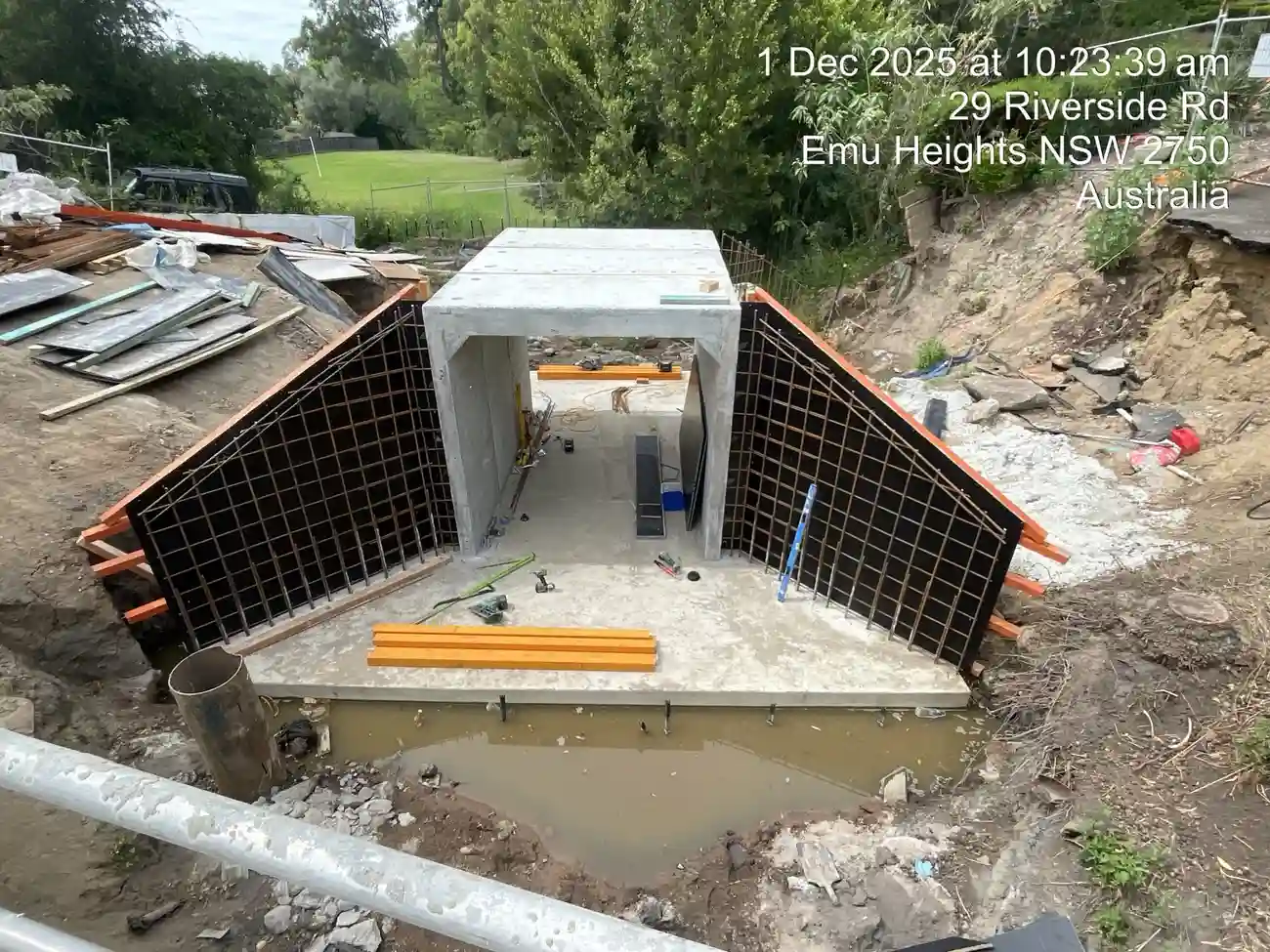
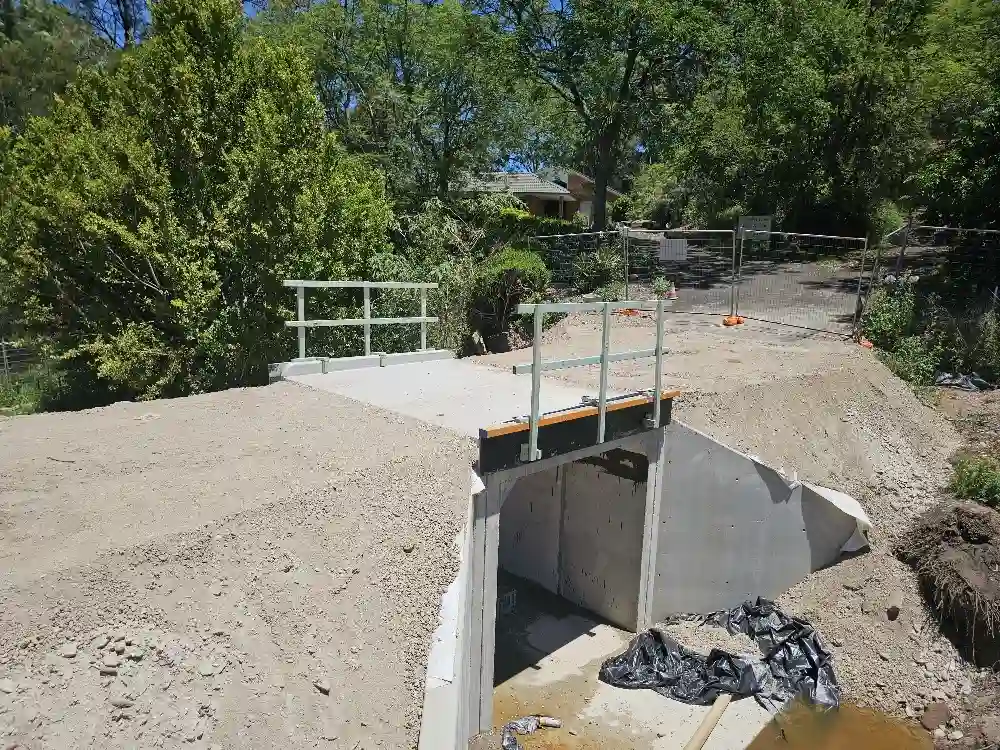
At SCE's Emu Heights bridge reconstruction, temporary access and groundwater management supported screw-pile foundations, excavation, a reinforced base slab, twin box culverts, wing walls and backfilling. The completed crossing depended on those connected construction stages. Frank MANESH's Epping–Thornleigh stormwater civil works career experience provides a further example of underground-service interfaces.
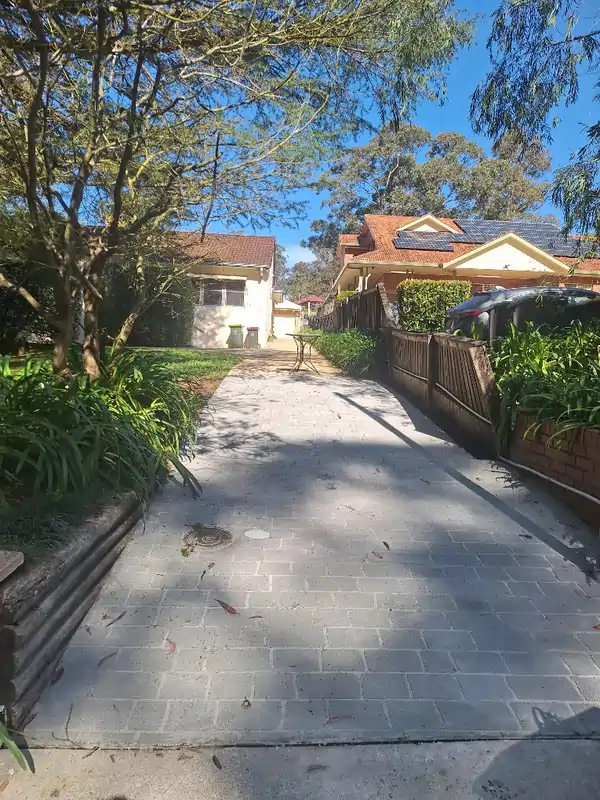
SCE's Normanhurst driveway replacement involved underground services beneath the work area. Bored piers formed part of the reconstruction strategy to transfer loads away from sensitive service zones. This illustrates why replacing the visible surface alone may miss the construction problem below it.
Frequently asked questions
It can provide project-specific information about levels, structures, drainage, materials, services and other technical requirements. Construction teams then coordinate the accepted information with site conditions, sequencing, responsibilities and required inspections.
Responsibility depends on the project's appointments and applicable requirements. Consultant, designer, certifier and registered-practitioner duties remain with the appropriately appointed parties and are not transferred simply because a contractor coordinates construction.
The team should confirm the applicable scope, accepted document revisions, site constraints, responsibility boundaries, required approvals, inspection points and any outstanding information affecting the proposed activity.
They should be recorded and managed through the project's controlled query, review and approval process. The team should identify the affected activities and obtain the required direction before proceeding where the change influences the accepted scope or information.
Project-specific engineering input may be required where defects, deterioration, movement, drainage, structural capacity or proposed repair work need technical assessment or design. The exact role and deliverables should be defined for the project.
SCE delivers integrated engineering and construction services, including design-and-construct and EPC delivery through established multidisciplinary engineering relationships. Provide the project objective, location, available documents, known site constraints and target programme so SCE can assess methodology, procurement, staging and the engineering inputs required.
For more practical construction and project-planning guidance, visit the SCE Blog.
Define the delivery need
Share the site location, project objective, current information, known constraints and required scope. SCE will assess the engineering interfaces, construction methodology, procurement and staging needed to deliver the project.